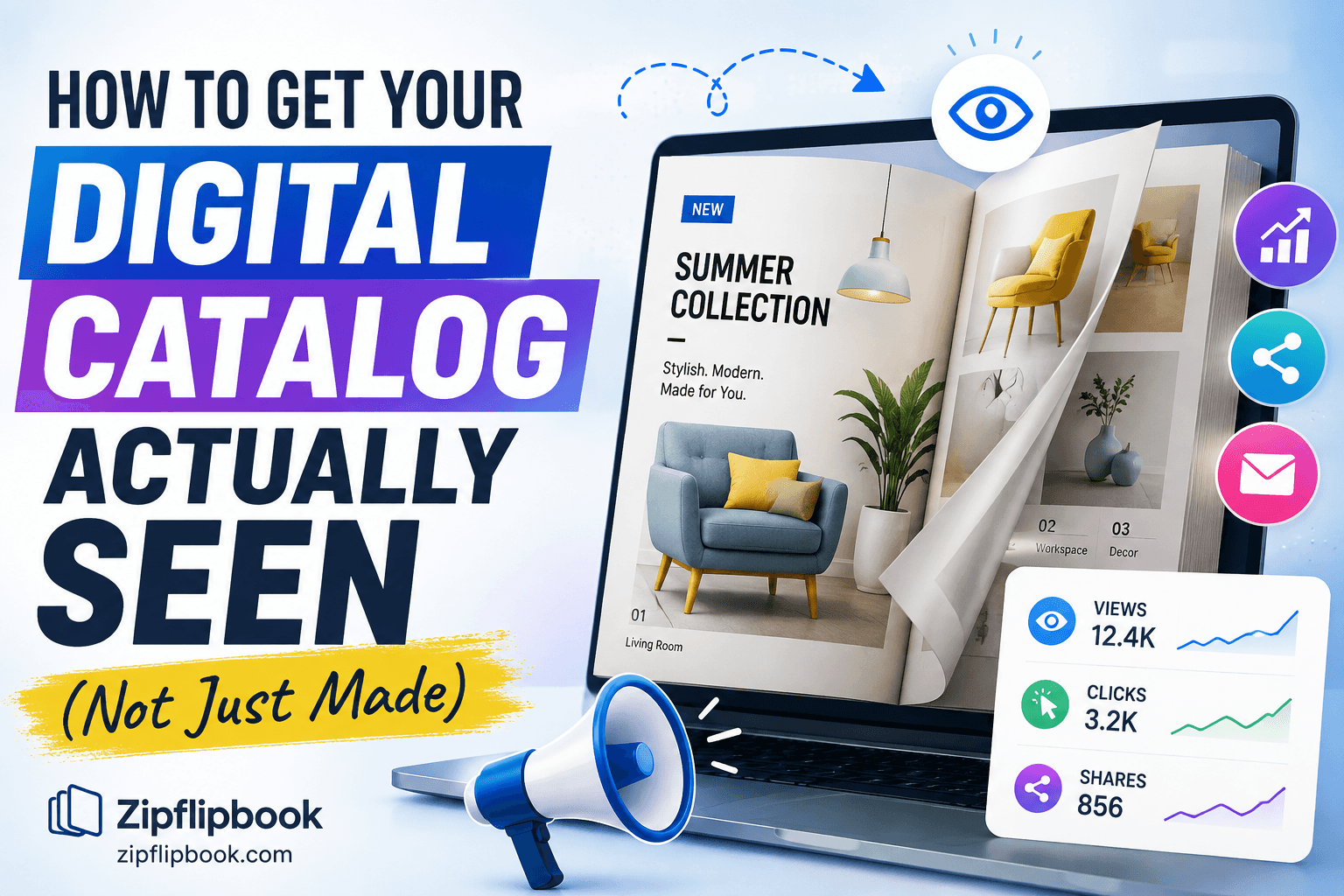
I started ZipFlipbook after my third "premium" flipbook tool gave me a beautiful animation and zero actual readers. The pattern was always the same: great presentation, terrible distribution. For the first year of running this thing I made the same mistake I see almost every user make. I obsessed over the flipbook itself. The page-turn animation, the embedded video working just right, the cover thumbnail looking sharp. Meanwhile the actual catalog was sitting on a URL that nobody outside my own bookmarks bar ever visited.
Nobody told me this when I was designing my first catalog, but making the thing is maybe ten percent of what matters. The other ninety percent is getting it in front of people who'll actually open it. Learned this one the hard way. Client's supermarket catalog, three weeks of design work, genuinely looked great. Forty views in its first month. I asked my mom if she'd seen it and she said "what catalog?"
So let's talk about what actually moves the needle, because it's not more animation effects.
The flipbook itself needs to pull its own weight
Before you even think about promotion, the flipbook page has to be built so it can be found and shared without friction. This part gets skipped constantly because it's boring compared to picking fonts.
Embedding is table stakes. If your flipbook lives on exactly one URL, you're invisible anywhere else. Drop it into a client's site, a partner's newsletter, your own blog — anywhere there's already traffic. I've had client flipbooks get more traffic from being embedded on a real estate agent's listing page than from the client's own homepage, simply because that page already had an audience.
Sharing needs to be brain-dead simple. A real button, not a URL that looks like a ransom note. And for the love of god, make sure the social preview image works. A blank gray box on LinkedIn is a guaranteed skip. I've watched a beautifully made brochure get shared into a group chat and show up with no thumbnail, no title, nothing. I'm lazy. You're lazy. We're all lazy. If the preview is broken, nobody's clicking.
Third, and this is the one people skip most: the page hosting your flipbook needs actual SEO basics. A proper title tag, not "Untitled Document 3." A meta description that tells a human what's inside before they click. Alt text on any preview images. If you're on a platform that lets you customize the page slug, use words people are actually searching, not a random string of characters. I made this mistake myself with an early wedding photography flipbook page and it sat un-indexed for six weeks because the URL was basically gibberish and Google had zero signal about what the page contained.
None of this gets you traffic on its own. What it does is make sure that when traffic does show up, whether from a search, a shared link, or an embed, it actually converts into someone opening the catalog instead of bouncing off a confusing page.
Distribution is where the real work starts
Okay, so your flipbook page is solid. Now you have to actually get people to it, and this is where most small business owners just stop, because it feels like a different job entirely. It kind of is.
Start where you already have a foothold. Your email list, even if it's 50 people, beats a cold audience of 5,000 — those people already gave you permission to talk to them. Send the catalog with a direct reason to open it, not just "check out our new brochure." I've had way better open rates with subject lines like "the new fall lineup is smaller this year, here's why" than anything that just announces a product update.
Social media: if you post it once and ghost, don't expect much. What actually worked for clients: posting the same catalog five times, three weeks, different angle every time. One post highlights a specific product. Next one, a video of someone flipping through on a phone. Different hook, same catalog, instead of one post that gets seen by maybe six percent of your followers before the algorithm buries it.
Partner sites are underrated. If you're a supermarket with a weekly catalog, where's the local Facebook group? The neighborhood app? The local news site that loves grocery deals? Getting your catalog linked or embedded there does two things at once. It puts you in front of an audience that already trusts that source, and it starts building the kind of off-site presence that search engines actually reward.
Directories are boring, but they work. Local business directories, industry listings, chamber of commerce pages — it's unglamorous, but it compounds. I know a property listings site that added their digital brochure link to four regional directories and saw a slow, consistent trickle of traffic start within about a month, nothing explosive, just steady.
Backlinks are the part nobody wants to deal with
"Backlinks" sounds like something only SEO agencies care about. It isn't. Here's the practical version of why it matters for something as simple as a digital catalog.
Search engines care less about what you say about yourself and more about what other sites say about you. Zero backlinks means basically invisible, no matter how well you wrote the meta description. It's like opening a great shop on a dead-end street.
Don't chase hundreds of backlinks overnight. That's how you end up with junk links that do more harm than good. The goal is a handful of relevant, real links pointing back at your catalog page from sources that actually relate to your business, whether that's a local directory, a partner's site, or a guest mention somewhere in your industry. Quality beats quantity every single time, and I say that as someone who's watched a client's rankings actually drop after a previous agency dumped a pile of low-quality links on their site trying to look impressive fast.
What this actually looks like put together
None of this works alone. Built-right page, multiple audience touches, partner sites, backlinks — each one amplifies the others. They're not a checklist, they're a system.
That supermarket catalog I mentioned earlier, the one that got 40 views in its first month? We went back and fixed the page SEO, embedded it on two local grocery deal sites, sent it out across three separate email sends instead of one, and picked up a handful of relevant backlinks over the following six weeks. Month three: 2,000+ views. No secret trick. Just did the boring distribution work I should've done from day one.
Making the flipbook was never the hard part. Getting it seen is the whole job. Wish I'd figured that out before launch, not after.