A zine costs next to nothing to make. You finish the last page, export a PDF, and then realise you have no idea what to charge, where to list it, or how a stranger is supposed to get the file without you emailing it by hand at eleven at night. That gap between "done" and "sold" is where most digital zines quietly die in a Downloads folder.
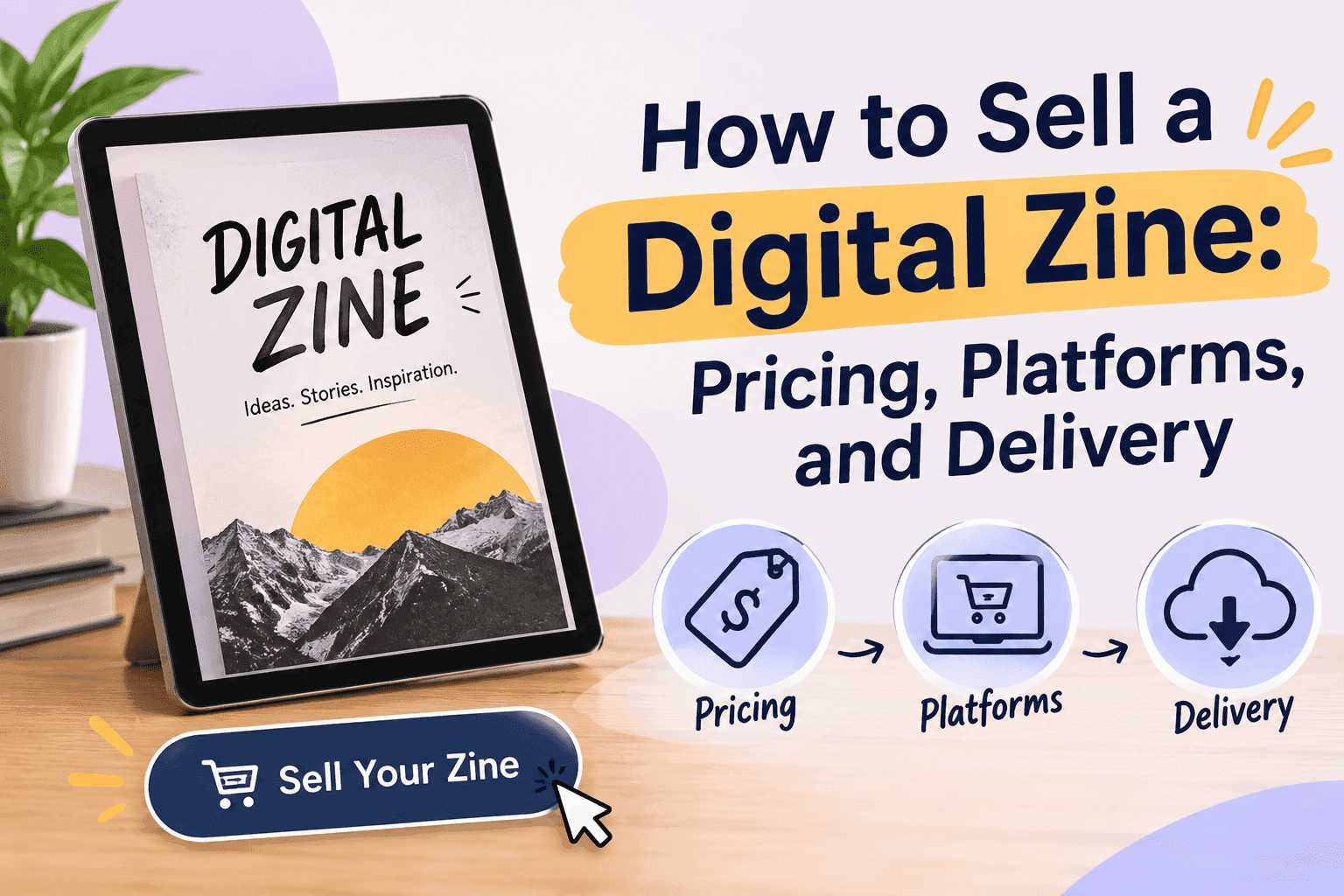
If you want to sell a digital zine, you need three decisions made before anything else: what the price is, which platform takes the money, and how the reader ends up holding the thing. Get those three roughly right and the rest is mostly telling people it exists.
Decide what the buyer actually receives
Most people default to a PDF because that is what the layout software spits out. Fine. But a PDF is only one way to hand over a zine, and it changes what you can charge.
A plain PDF download is the cheapest-feeling format. People have been trained by years of free PDFs to expect them to cost nothing, so a download alone is a hard sell above a few dollars unless the content is unusually good or the audience already knows you. A flipbook, where the reader opens a link and turns pages on screen, feels closer to a magazine. It has a cover, a page turn, sometimes sound. If your zine is built around spreads and a certain pace of reveal, that format keeps the pacing intact in a way a scrolling PDF viewer does not. We wrote about making the digital version feel like the real thing in how to make a digital zine that actually feels like a real zine, and most of that advice applies directly to anything you plan to charge for.
Then there is the bundle: PDF for keeping, flipbook link for reading on a phone on the bus. It costs you nothing extra to offer both, and it gives you a reason to price a little higher. Some buyers want a file they own. Others want to tap a link and read it right now. Offering both stops you losing either.
Page count changes what the product is. An 8-page single-fold zine and a 40-page photo zine are different products. Buyers do judge by size, even when the file is just a PDF with no physical weight. If you have a short zine, sell it cheap or give it away. If you have a long one, make sure the preview shows enough pages to prove the length.
Turn Your PDFs into Lead Generation Machines
Start getting highly-qualified leads from your PDFs and landing pages today. It takes exactly 2 minutes to set up.
No credit card required • Sign up in 10 seconds
What to charge
There is no official rate, but there is a rough market. Short text or illustration zines of 8 to 16 pages mostly sit between $1 and $3. Longer zines, 24 to 48 pages, with real photography, original art, or something useful like a recipe collection or a field guide, usually land between $4 and $10. Anything above that needs either an established audience or a very specific subject, such as a game supplement or a technical reference, where the reader would otherwise spend hours finding the same information.
Before you pick a number, a few pricing patterns are worth copying.
Pay-what-you-want with a minimum works on itch.io and Gumroad. The floor is the point: set it at $2 and plenty of people pay $5; set it at zero and most pay nothing. If you want the goodwill of "name your price" without the downside, keep a floor.
Sell the print and digital together if you also make a physical run. A common split is a physical copy at $6 and a digital copy at $2 or $3, with the digital one thrown in free when someone buys the print. That helps zine fair customers who want to share the digital version with a friend.
Do not price below about $1.50 unless the platform has a very low fixed fee. Payment processors take a flat amount per transaction, typically around 30 cents, on top of a percentage. On a $1 sale that flat fee can eat a third of your income before the platform takes its cut. Check the current fees on whichever platform you choose, because they change, and I would not trust any figure in a blog post, including these.
Free still has a job: it's a sampler and an email-list tool. A short free issue is how you tell people about the paid one later. If you go this way, put the free version behind an email form instead of a bare download link. ZipFlipbook has lead capture built in on the free plan, so the reader enters an email before turning the first page, and you can see in the analytics how many people opened it and how far they got. We cover that side of it in how to collect leads with PDFs using ZipFlipbook.
Raise your price once the first few buyers have come through without complaining. Most zine makers set the price too low out of nerves and then never touch it again.
Where to sell it
Pick a platform by asking two things: who already browses there, and what cut it takes.
Gumroad is the simplest route from a finished PDF to a payment link. Upload the file, set a price, get a URL. It handles delivery, receipts and a small audience tool for emailing buyers. The cost is a flat 10 percent of each sale plus payment processing, which stings on cheap items. It does not bring you many buyers on its own, so you will be sending your own traffic to the page.
Itch.io is where games live, but its tabletop and zine corner has grown a lot, especially for RPG zines and anything adjacent to indie game design. The revenue share is set by you, defaulting to 10 percent, and you can set it to zero if you want. Pay-what-you-want is native to the platform. If your zine is about games, itch is probably your best first stop. If it is about gardening, it is not.
Etsy has the biggest built-in audience of any of these. A digital download listing costs 20 cents to publish, and then Etsy takes a transaction fee of around 6.5 percent plus its payment processing fee. People search Etsy for printables and downloadable art, so zines with a strong visual cover do well there. Two limits matter: each listing allows up to five files, and each file has a 20 MB ceiling. A 32-page full-colour zine exported at print resolution can blow past that, so you will probably need a lighter screen-resolution PDF for the listing. Etsy is also crowded. Your listing sits next to hundreds of planner templates, so the thumbnail does most of the work.
Ko-fi suits makers who already have a following and want a shop tab alongside tips. The free tier takes a percentage of shop sales, and the paid Gold plan removes that cut for a monthly fee. Do the arithmetic with your own sales; Gold only wins after enough volume.
Payhip sits between Gumroad and a full shop. It has lower fees on its free plan than Gumroad charged for years, handles EU VAT automatically, which saves real paperwork if you have European buyers, and lets you offer discount codes and bundles without paying anything up front.
Your own site with a Stripe payment link or a simple checkout means you keep nearly everything, apart from Stripe's processing cut of roughly 2.9 percent plus 30 cents in the US. You also own the customer list. You'll do delivery, refunds, and traffic yourself. For a first zine I would start on Gumroad or itch and move to your own site once you know people want what you make.
List on one platform first. Zine makers love to spread across five marketplaces in week one, then forget which one has the up-to-date file. Pick one, get your first ten sales, and expand from there.
Getting the file to the buyer
Delivery sounds boring until it breaks. Someone pays, the download link expires, and you are answering a polite but irritated email on a Sunday.
Compress the PDF. A zine exported from InDesign or Affinity at print quality can run past 80 MB, which is far too heavy for a phone connection and too large for most email attachments. For screen reading, 150 dpi is plenty. A 24-page zine should come out between 5 and 15 MB. If your file is bigger than that, the culprit is usually uncompressed photos. We went through the tools for shrinking heavy files in how to optimize large PDFs for lightning-fast online flipbooks, and the same tricks cut a zine PDF down fast.
Number your pages and name the file properly. "zine-final-v3-REAL.pdf" in a customer's downloads folder does not make a good impression. Something like "nightshift-zine-issue-2.pdf" does.
If you are offering a flipbook alongside the PDF, send the link in the receipt email and again on the thank-you page. Buyers lose receipts. Put the link somewhere they can find it later, such as a members page or the product page itself on platforms that allow repeat access. On ZipFlipbook, you upload the PDF and get a shareable link or an embed code, so the same file can live as a download on Gumroad and as a readable flipbook on your site.
Check the mobile experience yourself before you sell anything. Open the download link on your own phone, on a cellular connection, with your Wi-Fi off. If the PDF takes twenty seconds to load or the text is too small to read without pinching, your buyers will have the same experience and some of them will ask for refunds.
Turn Your PDFs into Lead Generation Machines
Start getting highly-qualified leads from your PDFs and landing pages today. It takes exactly 2 minutes to set up.
No credit card required • Sign up in 10 seconds
Light-touch protection
Someone will share your zine. A buyer forwards it to a friend, or a copy appears on a file-sharing site within a week of release. Assume it will happen. DRM on a $3 zine costs you more goodwill than it saves.
Password protection and DRM on a $3 zine annoy honest buyers and barely slow down anyone determined. A light touch works better. Put your name and website on the first and last pages and on a footer line inside the layout, so a shared copy still points back to you. A small "issue 2, please don't pass this around, I make these on weekends" note on the inside cover works surprisingly well. Readers who like the zine tend to respect a human asking nicely.
If you want some control, a flipbook link lets you see how many times it has been opened and from where, which tells you quickly whether a single link is being passed around. That is information a raw PDF can never give you.
Telling people it exists
Listing a zine and waiting doesn't work. Nobody finds it. You have to send them.
Start with zine communities on Instagram and Bluesky, especially if you post page previews, work-in-progress spreads, and the occasional cover reveal. Post two or three inside pages, not just the cover. People buy zines based on the interior.
Newsletters are slower but more reliable. A free sampler issue that captures an email address gives you a list of people who already like what you make, and the second paid issue sells to them far more easily than it sells to strangers.
Zine fairs, in person or online, are still the best place to find readers who already pay for zines. Take a QR code on a card that links to the digital version. It costs a few pence to print and turns every passerby into a possible buyer even if they walked past without cash on them.
Poetry and personal-writing zines in particular do well with smaller, loyal audiences, and the economics look different from a visual art zine. If that is your area, the beginner's guide to poetry zines and self-publishing covers how those makers think about pricing and audience.
And if you have not built the thing yet, the free tools matter. Our roundup of the best free zine makers compares what is out there, so you can pick a layout tool before you spend a weekend fighting one.
FAQ
How much should I charge for a digital zine?
$3 is a safe start for a 20-page zine. I'd only go past $8 for something people would otherwise spend hours piecing together, like a game supplement or a regional field guide.
What is the best platform to sell a digital zine?
Gumroad takes about ten minutes to set up. Use itch.io instead if the zine is about games, and Etsy if the cover is strong enough to win a click from a search thumbnail.
Can I sell a zine as a PDF without losing money on fees?
At $1, a 30-cent flat fee plus a 10 percent platform cut already takes about 40 percent. On $3 the same fees take closer to a fifth.
Should I sell a digital zine as a flipbook or a PDF?
Both, if you can. Some buyers want a file on their laptop and some want to tap a link on the bus, and the pair justifies another dollar.
How do I stop people sharing my digital zine?
You can't. Put your name and URL on the first and last pages, and if you use a flipbook link, watch the open counts for a sudden spike from places you've never sold to.
Do I need a website to sell a zine?
No. A Gumroad or itch page is enough for the first ten sales; a site can wait until there are people to send to it.