Take the home renovation contractor in Austin who emailed me last month. He'd been attaching a 12MB PDF to every client proposal — the kind of file that makes people's email app choke before they even open it. When we swapped it for an embedded flipbook instead, his proposal open-rate went from 40% to 85% in a week. Same content, same pricing, same pitch. The only thing that changed was whether the document actually got opened.
That's basically the whole argument for this article. For the last three years, while building flipbook software, I've sat through dozens of calls with small business owners, and almost every single one started with a sigh when I asked about Issuu. Not because Issuu is broken — it's not — but because most of the content comparing flipbook tools reads like it was written by someone who's never actually run a small business trying to stretch a marketing budget.
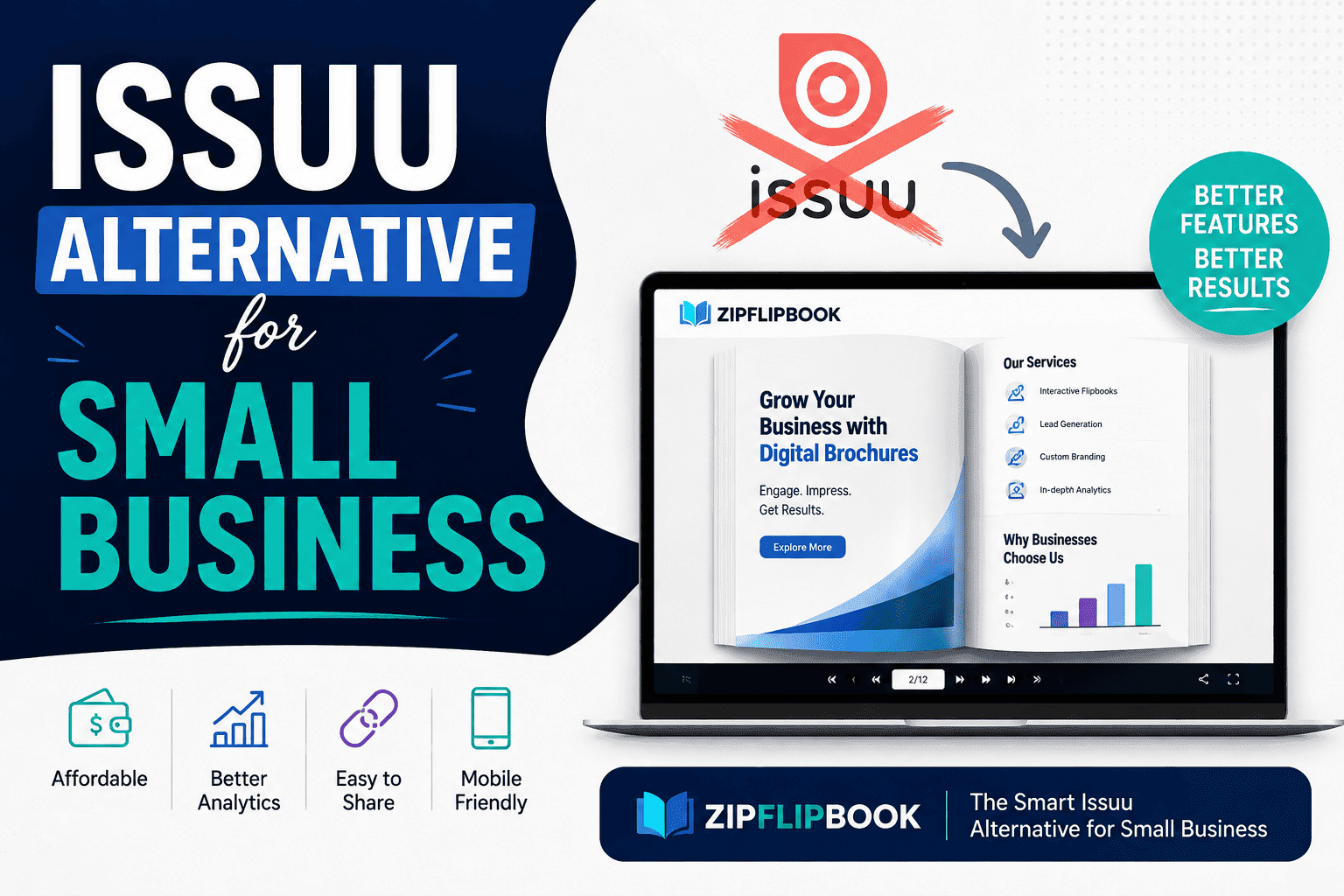
Why People Even Start Looking for an Issuu Alternative
Issuu isn't a bad platform. I want to say that up front because too many "alternative" articles pretend the incumbent is garbage, and that's just not true. It's been around a long time, it works, and plenty of publishers use it happily.
But small businesses aren't publishers. That's the mismatch.
If you're a boutique running a seasonal lookbook, a contractor sending out a services brochure, or a restaurant putting together a digital menu, you don't need a publishing platform built for magazines and media companies. You need something fast, cheap (or free), and simple enough that you don't have to think about it twice a year when you update your catalog.
Here's where the friction usually shows up:
The free plan isn't really free. You get a certain number of publications, then you hit a wall. Or your reader gets served ads on your own content, which is a strange thing to explain to a customer who just wanted to look at your product line and instead got an ad for something unrelated.
Branding gets murky. When you share a flipbook, does it look like your brand or does it look like it's hosted by someone else? A lot of small business owners don't notice this until a customer says "hey I saw your catalog on Issuu" instead of just seeing it as part of your website.
It's built for volume, not for focus. Issuu's strength is handling huge content libraries for people who publish constantly. If you're uploading one brochure and updating it twice a year, you're paying for infrastructure you don't need.
Analytics and lead capture are locked behind paid tiers. And this is the one that actually costs you money. If you can't see who's opening your brochure, how far they're reading, or capture their email before they view it, you're basically just hoping the PDF does its job in the dark.
None of this makes Issuu wrong. It just makes it the wrong tool for a huge chunk of the people searching for it — and it's why "Issuu alternative" is one of the most searched phrases in this space. People aren't looking for a worse Issuu. They're looking for a tool sized to what they actually need.
What Small Businesses Are Actually Trying to Solve
I built ZipFlipbook because I ran into this exact wall myself. I had a PDF, I wanted it to feel like something worth clicking on instead of a flat download, and I didn't want to sign up for a publishing suite designed for a media company with a content team.
Forget the feature tables. When you're comparing these tools, here are the only five questions that actually matter for a bootstrapped business.
- Can I use it without paying, at least to start? You should be able to test a real flipbook, not a crippled demo.
- Does it capture leads without extra plugins? If someone's flipping through your catalog, that's a warm moment. You want their email before they close the tab, not after.
- Can I see analytics that mean something? Page-level engagement, not just "12 views."
- Does it embed cleanly on my own site? If your flipbook lives somewhere else and you just link to it, you're sending traffic away from your own domain for no reason.
- Is the output actually fast to load? A flipbook that takes eight seconds to render on mobile is worse than just linking the raw PDF.
If a tool checks those boxes, you're in decent shape. If it doesn't, you're going to hit the same walls people hit with Issuu, just with a different logo on it.
Why I Think ZipFlipbook Is the Better Fit for Small Business
Look, I'm the founder of ZipFlipbook. Of course I'm biased. But I built this specifically because I got tired of the workarounds Issuu forced on my own agency clients back when I was still running SEO for tradespeople and small businesses instead of building software for them.
It's browser-based, no software, no export process. You upload a PDF, and it converts into a flipbook right there. No desktop app, no waiting on a render queue, no "check your email in ten minutes" nonsense.
Lead capture is built in, not bolted on. You can gate your flipbook behind an email capture form if you want to, so instead of just tracking a vague view count, you're building an actual list of people who cared enough to open your brochure.
Analytics that tell you something useful. You can see how far into the flipbook people actually got, which pages people lingered on, and where they dropped off. That's the kind of data that tells you whether page 4 of your catalog is doing its job or whether people are bailing before they ever see your pricing page.
Embedding is simple and it's yours. You can drop a flipbook directly into your own website so it feels like part of your site, not a redirect to somebody else's platform. That matters more than people think — customers trust content that stays on your domain.
It's free to use. I built it as a free tool because I think gating basic PDF-to-flipbook conversion behind a paywall is exactly the kind of thing that pushes small businesses away in the first place. You shouldn't need a marketing budget just to make your catalog look decent.
Media embedding for people who want more than static pages. If you want to drop a product video or a testimonial clip into a page of your brochure, you can, without needing a separate video hosting setup glued on top.
I built ZipFlipbook after running into a hundred small versions of this exact problem at Slingshot Marketing. Every client wanted something simple: turn the PDF into a flipbook, get it on the site, see who's actually looking at it, don't make it complicated.
Turn Your PDFs into Lead Generation Machines
Start getting highly-qualified leads from your PDFs and landing pages today. It takes exactly 2 minutes to set up.
No credit card required • Sign up in 10 seconds
A Quick, Honest Comparison
I'll give you the short version instead of a giant feature table nobody reads all the way through.
Issuu is best if you're a publisher with a large content library and you want discoverability inside Issuu's own reader network. It's less ideal if you're a single-location business publishing one or two documents a year and don't want your brand sharing space with someone else's platform.
Flipsnack and FlippingBook are great if you want to spend 45 minutes picking a template before you upload anything. Both have real strengths if you're doing heavy design work — page-turn animations, custom themes, the works. But honestly, that's a huge pain in the ass for a restaurant owner who just wants this week's specials online before the lunch rush. If you want it live in two minutes, that's not really what those tools are built for.
ZipFlipbook is built for the business owner who wants the brochure done today, wants to know who's reading it, and doesn't want a monthly bill for something they update twice a year.
None of these are wrong answers. But if your business fits the profile of "I have a PDF, I want it to look good, and I want to know if it's working," you're probably going to find ZipFlipbook does what you actually need without the extra weight.
Why That Contractor Story Actually Matters
I don't care if your brochure has 3D page curls. I care if you know which page made the customer stop scrolling. That's the whole point of this tool. The Austin contractor didn't need a fancier PDF — he needed to see that his old delivery method was quietly killing his own pitch before it even got read. The flipbook didn't fix his sales pitch. It just stopped hiding whether the pitch was landing.
Another Example, Because One Data Point Isn't Enough
A wedding photographer client of mine in Manchester was using Issuu's free tier for her portfolio, and she'd hit the publication cap twice in six months — meaning she had to delete an old wedding gallery just to upload a new one. That's a genuinely bad situation to be in when a bride is trying to compare your last three years of work before booking you. We moved her portfolio over to ZipFlipbook, embedded it directly on her site instead of linking out, and she stopped worrying about caps entirely because there isn't one to hit. Small thing, but it's the kind of small thing that adds up to a business owner not thinking about their brochure tool at all — which, honestly, is the goal. You shouldn't have to think about your flipbook software. You should just be able to trust it's doing its job in the background while you focus on actually running the business.
Turn Your PDFs into Lead Generation Machines
Start getting highly-qualified leads from your PDFs and landing pages today. It takes exactly 2 minutes to set up.
No credit card required • Sign up in 10 seconds
Making the Switch
If you're currently on Issuu and thinking about switching, the good news is you don't need to blow up your whole workflow. Export your existing catalog as a PDF, upload it to ZipFlipbook, and you've got a working flipbook in minutes. Update your website embed, redirect any old links, and you're done. No migration headache, no "contact support to move your account" runaround.
If you're just starting out and haven't picked a tool yet, don't spend your afternoon signing up for five different trials. Drop one PDF into ZipFlipbook. If you don't like the look of it in five minutes, no hard feelings — you haven't lost a dime.
Small businesses don't need publishing platforms. They need tools that get out of the way and let the actual product or service speak for itself. That's what I built ZipFlipbook to do, and it's why I think it's the better Issuu alternative for anyone running a business instead of a magazine.