I get some version of this email at least twice a month: "We made a beautiful catalog. Nobody bought anything. What went wrong?"
Nine times out of ten, nothing went wrong with the catalog itself. The photography's fine. The layout's fine. The problem is that the catalog was treated as the finish line instead of the starting gun. Someone spent three weeks getting the product shots right, uploaded a PDF, put a link to it on the homepage, and then... waited. As if the catalog itself was going to reach out and close the sale.
It won't. It can't. A catalog, even a genuinely good interactive one, is a single station on a much longer track. If nothing picks the customer up after they've flipped through it, you've built a beautiful dead end.
The catalog is the hook, not the sale
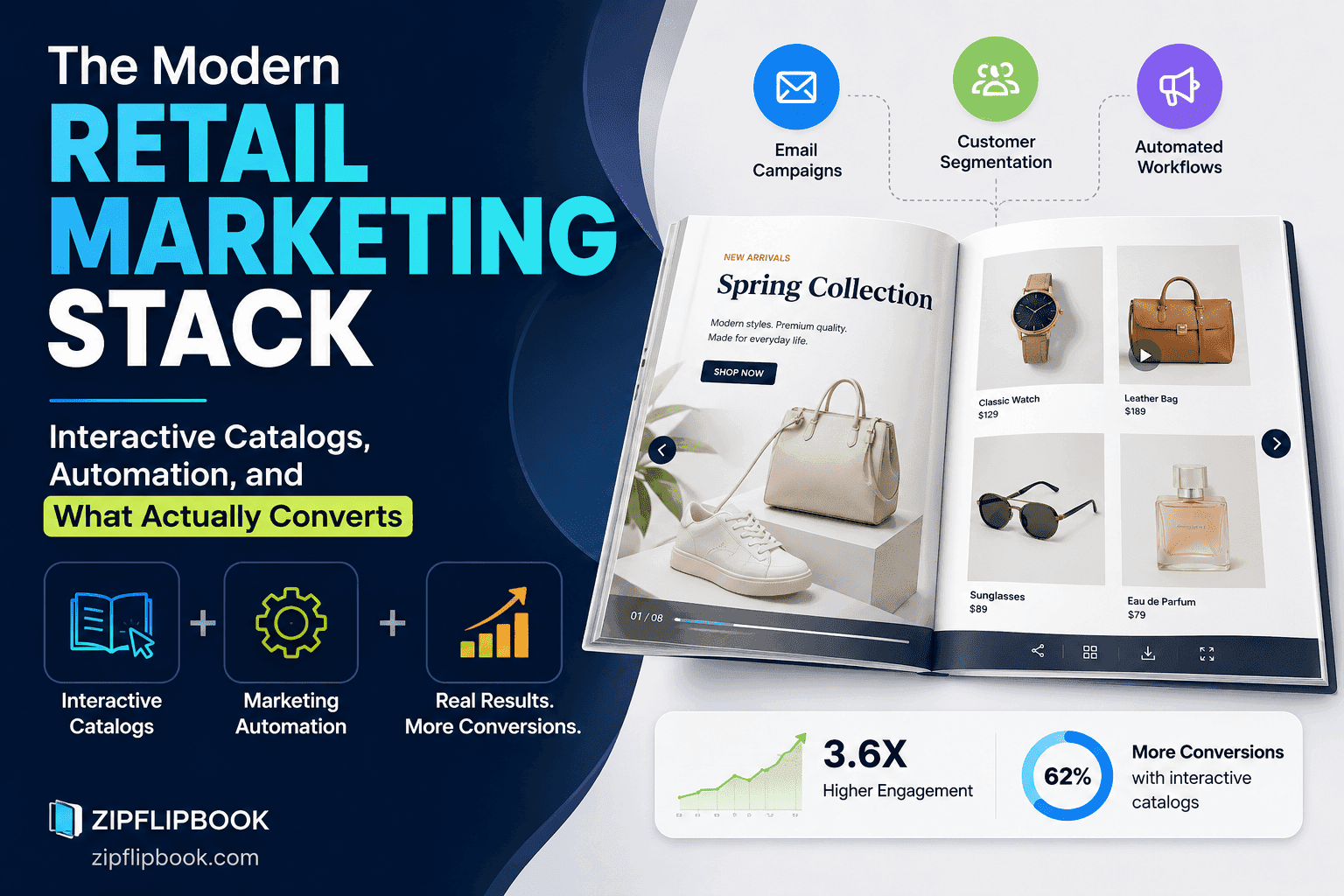
Let's start with the part I actually know something about, because I built a company around it. A flipbook-style catalog beats a flat PDF for one simple reason: people don't read PDFs, they skim them for four seconds and bail. A page-turning, embedded-video, click-to-zoom catalog holds attention longer, and — this is the part everyone forgets — it can capture a lead in the process. Someone flips to page six, sees a product they like, and instead of just closing the tab, they hit "request a quote" or drop their email for a size chart. That's the whole point of the format. It's not decoration. It's a funnel with a coat of paint on it.
But here's where most small retailers stop thinking. They get the lead capture working, they see a trickle of emails come in, and then those emails just... sit there. In a spreadsheet. Or worse, in someone's personal inbox, waiting for a "quiet afternoon" that never arrives. I've watched this happen to businesses with genuinely great products. The catalog did its job. The follow-through didn't exist.
The gap nobody budgets for
This is the part of the stack that gets skipped, and it's not because retailers are lazy — it's because nobody sells it to them as a single problem. They buy a catalog tool. They buy an email platform. Maybe they buy a CRM because someone told them to. None of these things talk to each other, so the "system" is really just three disconnected tools and a person manually copying data between them at 11pm.
What actually needs to happen is boring but non-negotiable: the moment someone raises their hand inside your catalog — downloads a spec sheet, requests a callback, browses the same category three times — something needs to act on that signal within minutes, not days. That's not a nice-to-have. That's the difference between a lead and a name in a spreadsheet nobody opens again.
This is where an AI marketing automation platform earns its keep. Not as a buzzword bolted onto a sales page, but as the layer that takes the raw signal your catalog produces — someone lingered on the winter jacket page for ninety seconds, someone bookmarked the same product twice — and turns it into an actual sequence. A follow-up email that doesn't sound like a form letter. A nudge three days later if the cart went cold. A different message entirely if the person came back a second time without buying. None of this requires a marketing team of six. It requires the pieces being connected instead of sitting in separate corners of your business pretending to cooperate.
A retailer that actually built the whole stack
I want to use a real example instead of talking in the abstract, because abstractions are where most of this advice goes to die. A gaming hardware review site covers keyboards, headsets, and controllers — the kind of thing where the buying decision genuinely benefits from seeing the product in motion rather than as a static thumbnail on a grid page. Mechanical keyboards. Headsets. The stuff where "does this actually feel right under my hands" matters more than it does for, say, a phone case
What made their approach work wasn't a single clever trick. It was that they didn't stop at the catalog. Their seasonal gear catalog wasn't just a PDF turned into pages — it captured interest at the product level, and that interest fed straight into automated follow-up instead of a general newsletter blast. Someone who lingered on the tent section got a different message than someone who spent all their time in footwear. That sounds obvious written down. It is obvious. Almost nobody does it, because doing it requires the catalog and the automation to actually be talking to each other, and most small retail setups have those two things bolted together with duct tape, if at all.
The result wasn't a viral moment or some dramatic overnight spike — retail rarely works that way, and anyone promising you it does is selling something. It was a steadier, more boring kind of improvement: fewer leads going cold, fewer "I meant to follow up with that customer" moments, and a catalog that was actually pulling its weight instead of sitting there looking pretty.
What this looks like if you're starting from zero
If you're a small retailer reading this and thinking "great, now I need six new tools," that's not the takeaway. The stack doesn't need to be complicated. It needs three things to actually exist and actually connect:
First, a catalog format that captures interest instead of just displaying products — which is the whole reason I built ZipFlipbook the way I did. A static PDF gives you zero data. An interactive one at least tells you where attention is going, and that information is worthless if nothing downstream ever sees it. And if you sell physical products, it helps to have a steady stream of people arriving in the first place, which is where a Google Shopping feed tool earns its place: it keeps your product data clean and consistent across listings, so the catalog isn’t your only source of traffic.
Second, a way to act on that interest without a human manually noticing it happened. This is the automation layer, and it's the one most businesses skip because it feels like a "later" problem. It isn't. It's the difference between a lead you monetize and a lead you apologize for three weeks later when you finally get around to emailing them.
Third — and this is the one nobody wants to hear — actual follow-through discipline. Automation removes the excuse of forgetting, but it doesn't remove the need to occasionally look at what's happening and adjust the messaging when it's clearly not landing. Tools don't run businesses. They just remove the parts of running a business that shouldn't require a human in the first place.
The mistake I keep seeing
If there's one thing I'd want a retailer to take from this, it's to stop treating the catalog as the deliverable and start treating it as the input. The catalog's job is to generate signal — who's interested, in what, and how much. Everything after that is where the actual revenue lives, and it's also the part that gets neglected because it's less visually satisfying than a nice page-turn animation.
Nobody gets excited about writing follow-up sequences. Everybody gets excited about how good the catalog looks. That mismatch in enthusiasm is exactly why so many small retailers end up with a beautiful, well-photographed dead end instead of a working funnel. The businesses that get this right aren't necessarily the ones with the best products or the biggest budgets. They're the ones who accepted that the catalog was never supposed to be the finish line, and built the rest of the track to match.