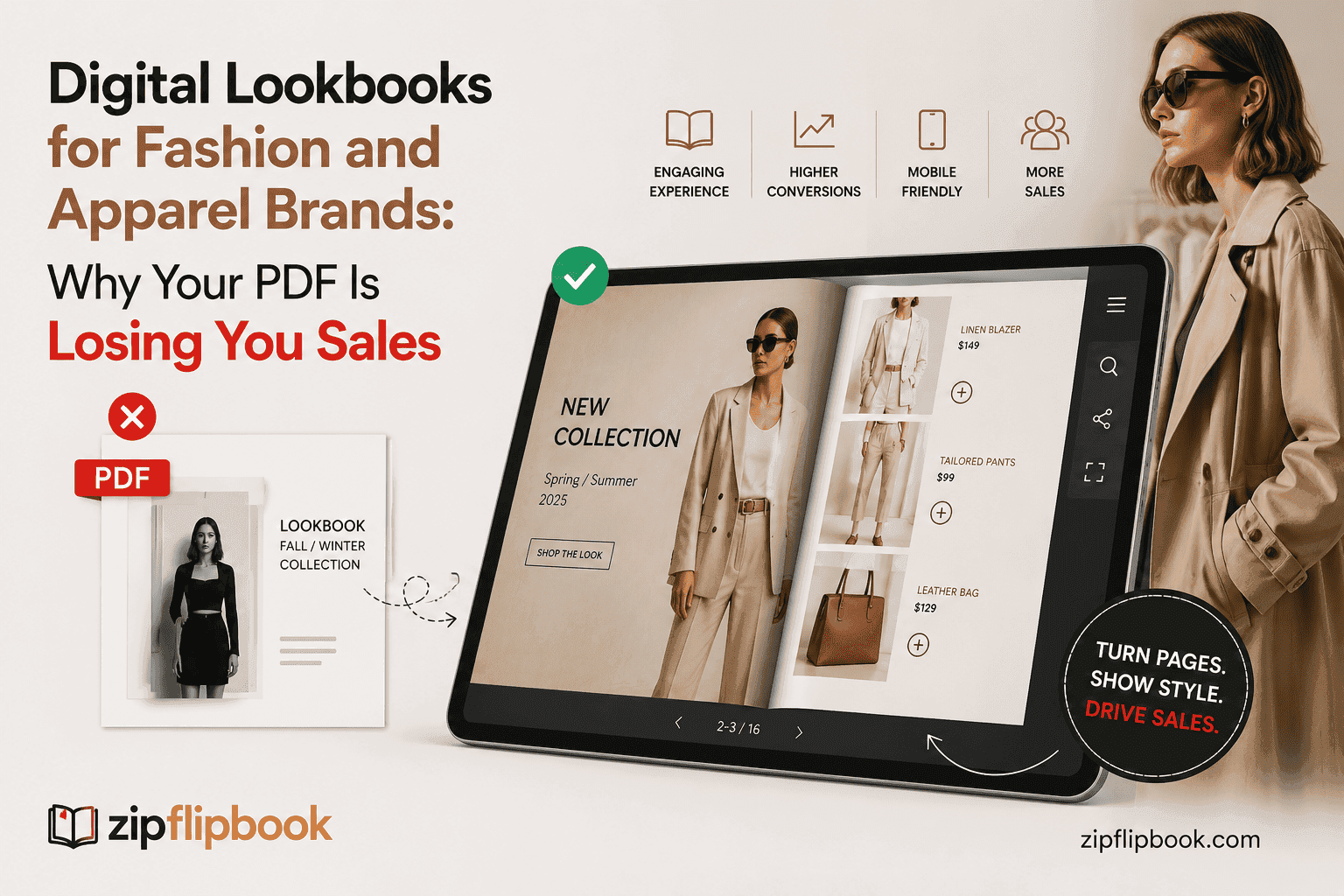
I sat through a presentation last spring where a brand had spent close to £40,000 on a lookbook shoot — stylist, model, a studio with proper light — and then emailed the finished thing out as a 28MB PDF that half the buyers on the list couldn't even get to open. No motion, no way to click through to a product page, no idea afterward whether anyone had actually looked at it. All that visual work, buried in a file format built for tax invoices.
A lookbook isn't a spec sheet. It's the closest thing a buyer or a customer gets to walking your showroom without actually being in it. If the format you're delivering it in feels like homework, you've already lost some of the emotional pull the collection was supposed to create.
What a lookbook actually has to do
A good lookbook does three things: presents the collection exactly as you styled it, makes it dead simple for someone to buy or enquire, and tells you who actually looked at it afterward. PDFs manage roughly zero of these. They render differently depending on the viewer's software, they can't hold video, and once you've hit send you're flying blind — no idea if a buyer skimmed page one and closed it, or spent four minutes on your outerwear section.
The page-turn effect is doing more work than you'd think
Print lookbooks still exist for a reason: turning a page forces a pause. You can't thumb through a glossy the way you scroll Instagram, and that slowness changes how the work lands. A digital flipbook borrows the same mechanic — pages turn instead of scroll, spreads render the way they were designed rather than getting squashed into a single column, and the whole thing reads more like an editorial than an email attachment.
That matters more in fashion than in almost any other category, because so much of what you're selling is a feeling. A knitwear collection styled against a specific set and lit a specific way is communicating mood as much as product. Chop that into a vertical scroll and you lose the pacing the photographer and stylist built in. Keep it as spreads that turn, and the story survives the trip from InDesign to a buyer's inbox.
Turn Your PDFs into Lead Generation Machines
Start getting highly-qualified leads from your PDFs and landing pages today. It takes exactly 2 minutes to set up.
No credit card required • Sign up in 10 seconds
Buyers want to click, not just look
Wholesale is where this becomes non-negotiable rather than nice-to-have. A buyer flipping through your Spring '27 lookbook shouldn't have to alt-tab to a separate line sheet to check a wholesale price, a minimum order quantity, or fabric composition. Every extra step is a chance for them to get distracted by the next brand in their inbox.
An interactive lookbook can carry that information right on the page — a hotspot on a garment that opens the SKU, the price break, and the available colourways without leaving the spread. Same goes for consumer-facing lookbooks: tap the jacket, land on the product page, add to cart. The lookbook stops being a lovely thing you look at and becomes a lovely thing that also converts, which is the whole point of making one in the first place.
Retailers building this out for general merchandise have already worked through a lot of these same problems — worth a look at digital retail catalog software built for small business buyers if you're weighing up what a proper catalog stack looks like beyond just the lookbook itself.
Video is where fashion actually pulls ahead of every other industry
Video in a catalog is usually pointless. For fashion, it's almost mandatory. A still photo tells you what a coat looks like. An eight-second clip tells you how it moves, how it falls, whether it feels heavy or light — that's the difference between "I like that" and "I want to try that on."
Embedding a short runway clip or a 360-degree spin directly into a lookbook page changes what the format can do. It's no longer a photo album with captions; it's closer to a mini presentation. And it doesn't need to be expensive — a phone-shot clip of a garment in motion, dropped straight into a spread, often outperforms an overproduced still because it feels more honest about what you're actually selling. I'd rather see a scrappy clip of a coat swinging than another perfectly lit flat lay.
Design details that separate a lookbook from a catalog
Lookbooks and catalogs aren't the same thing, and treating them like they are is where layouts fall apart. A catalog is a grid — get in, get out, find the price. A lookbook should feel like you're being walked through a room. You need more air, bigger images, less text competing for attention.
That said, borrowing a few catalog disciplines won't make your lookbook boring, it'll make it readable — consistent image sizing across spreads so nothing looks accidental, a clear hierarchy so the hero pieces don't get lost next to the accessories, enough breathing room that the collection doesn't feel cramped. There's a solid rundown of this in 10 design tips for product catalogs that actually maximize sales, and most of it holds up even once the tone shifts moodier than a straight catalog.
Stop guessing whether anyone opened it
You spent on the photographer, the model, the studio, the styling. Then you email the lookbook out as a PDF and... nothing. No open tracking, no page-level engagement data, no signal at all. You find out if the collection landed three weeks later when orders either show up or don't, which is like driving with the windscreen painted black in a business that lives and dies by seasonal timing.
With an interactive flipbook, you get actual signal — who opened it, how far they got, which pages they spent time on, whether they clicked through to a product. If your outerwear pages are getting three times the engagement of your accessories pages, that's useful information heading into a buying meeting or a reorder conversation. It's the difference between guessing what resonated and actually knowing.
This is the exact gap ZipFlipbook was built to close. Upload the PDF from your design software, and it turns into a page-turning, embeddable flipbook with built-in analytics, lead capture forms you can drop onto any page, and hotspots you can link straight to product pages or a wholesale enquiry form — all without touching a line of code. For a brand running seasonal drops, that means every lookbook you send out this year gives you data you didn't have last year.
Practical things to get right before you send it out
A few things worth nailing down regardless of which tool you end up using. Keep file sizes sane — high-res fashion photography adds up fast, and a lookbook that takes fifteen seconds to load loses buyers before page one even renders. Make sure it works properly on mobile, because a meaningful chunk of buyers and press will open it on a phone between meetings, not at a desk. And build in a clear next step on the last page — a contact link, a wholesale enquiry form, a "shop the collection" button — because a beautiful lookbook that ends with nothing to do next just leaves people scrolling back to their inbox.
Turn Your PDFs into Lead Generation Machines
Start getting highly-qualified leads from your PDFs and landing pages today. It takes exactly 2 minutes to set up.
No credit card required • Sign up in 10 seconds
Nobody's forced to change yet — that's the problem
Fashion brands have generally been slower than retail or real estate to move their core sales materials off static PDFs, partly because the format still looks fine on a screen and partly because nobody's had a reason to change something that isn't visibly broken. But "isn't visibly broken" and "isn't costing you sales" are different things. Every lookbook you send with no click-through, no video, and no engagement data is a missed chance to learn something about your own collection before the season's already over.
The photos are already done. The styling, the lighting, the mood — all of that's in place before you've even opened your laptop to send anything out. The only thing left is to stop shipping it as a file that looks like a terms of service agreement. A lookbook is usually the single most persuasive thing a fashion brand makes each season. It should feel like it, right up until the moment someone closes the tab.