I've watched a lot of retailers come through ZipFlipbook over the past year, and there's a pattern I see constantly. A store owner signs up, uploads a PDF catalog, gets a working flipbook in about a minute, and is thrilled. Three months later they're back asking why they can't see how many people actually opened page 12, or why their 40MB catalog with 200 SKUs chokes on someone's phone in a parking lot.
That gap between "this works" and "this actually helps my business" is where most flipbook tools fall apart. Not because the tool is broken. Because the tool was built for a simpler job than the one retail eventually demands.
Basic Flipbook Software Works Great Right Up Until It Doesn't
Basic flipbook software solves one problem extremely well: turning a flat PDF into something that feels less like a PDF. Page-flip animation, maybe a shadow effect on the corner, a fullscreen button. For a five-page lookbook or a one-off seasonal promo, that's genuinely enough. I built ZipFlipbook to nail that exact use case first, because most people don't need a platform, they need a converter that doesn't insult their catalog.
But retail isn't a one-off. Catalogs grow every season. Product lines get added and discontinued. Prices change. And somewhere in the middle of all that, a marketing team needs to know if any of it is actually working. The moment a flipbook becomes a recurring part of how a retailer sells, the requirements shift under it, and that's when the cracks in "basic" start showing.
There are three issues that show up first, almost every time.
Crack One: No Flipbook Analytics, No Idea Who's Reading
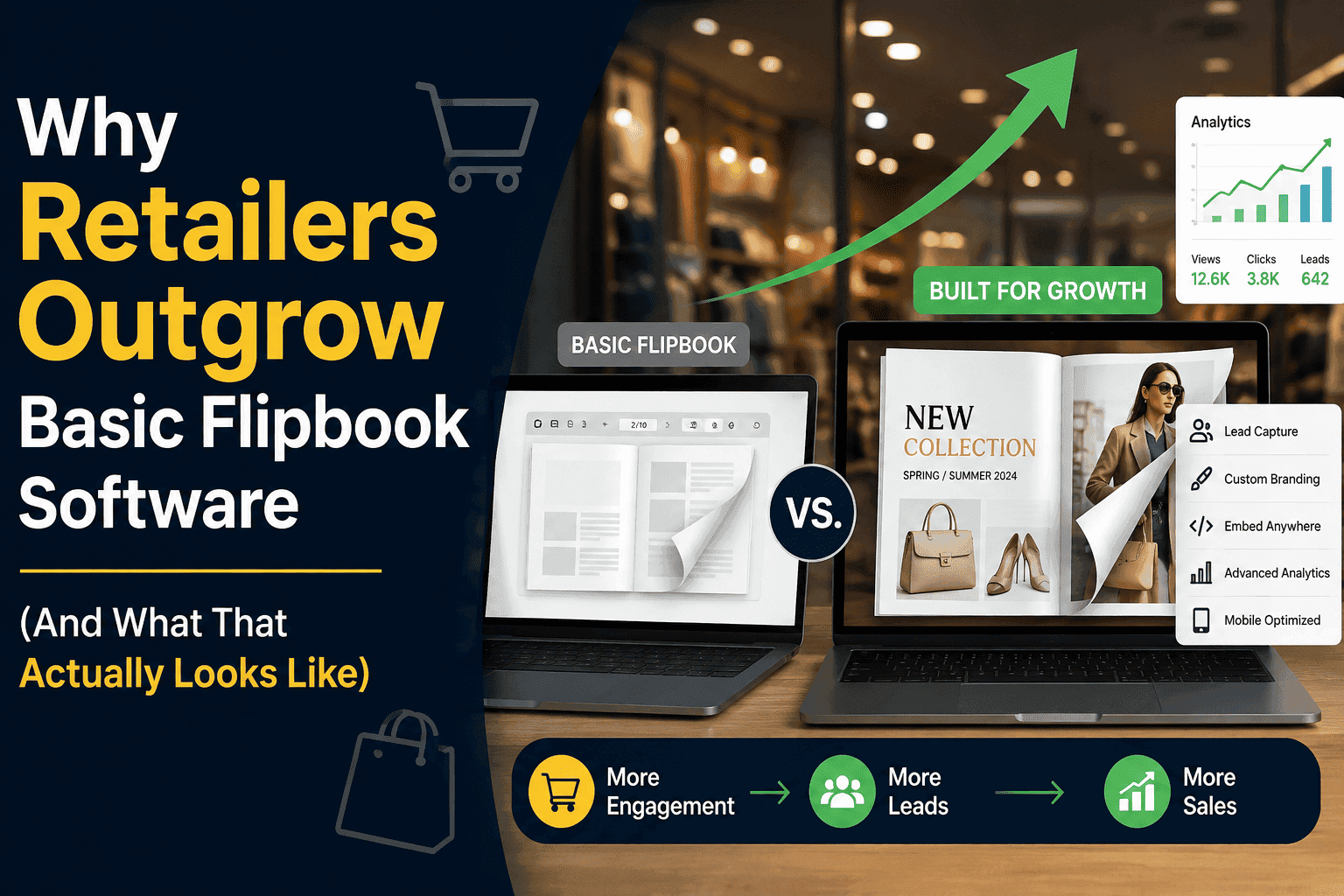
A retailer sends a digital catalog to 4,000 email subscribers. It looks great. It flips nicely. And then someone in marketing asks the obvious question: did anyone open it? Basic tools mostly shrug at this. Maybe you get a raw view count if you're lucky, no page-level detail, no way to tell which product spread actually held attention versus which one people bounced off immediately.
That's a real problem for retail specifically, because catalogs are supposed to inform buying decisions. If you don't know that everyone's skipping past page 8 (your patio furniture, say) and slowing right down on page 14 (your clearance rack), you're flying blind on merchandising decisions you could otherwise make with confidence. Page-level analytics were one of the first things I built into ZipFlipbook. I got tired of hearing "we sent it out" treated like a success metric. Sending isn't the goal. Someone stopping to look is.
Turn Your PDFs into Lead Generation Machines
Start getting highly-qualified leads from your PDFs and landing pages today. It takes exactly 2 minutes to set up.
No credit card required • Sign up in 10 seconds
Crack Two: Large Product Catalogs Slow Basic Flipbook Makers Down
A boutique clothing shop can run a 10-page lookbook without much trouble on almost any platform. A hardware store or a supermarket running a 150-page seasonal catalog with product photography on every page is a different animal entirely. File size balloons, and cheap flipbook renderers that weren't built with performance in mind start choking, especially on mobile.
This is the point where retailers start losing customers before those customers even see a product. Nobody waits twelve seconds for a catalog to render on 4G while standing in a store aisle comparing prices. I've rebuilt ZipFlipbook's rendering pipeline more than once specifically to keep load times sane as catalog sizes grow, because a flipbook that loads but doesn't render properly isn't a feature. It's a liability that happens to have a nice page-turn animation.
Crack Three: Watermarks and the Branding Ceiling on Free Flipbook Makers
This one's less technical and more about how seriously the tool treats you as a business. A lot of "free" flipbook tools slap a watermark or a branded footer on every catalog you publish, and plenty of retailers don't notice until a customer points it out or a competitor's polished, unbranded catalog lands in the same inbox. At that point the retailer has two options: pay to remove it, or keep looking like they're using a tool they haven't fully committed to.
I made the decision early with ZipFlipbook to keep the core flipbook conversion free without watermarks, because I think that particular trick is a cheap way to nudge upgrades and it annoys me every time I see another tool do it. If a retailer's catalog is doing real work, representing their brand to customers, it should look like their brand, not like an ad for whatever software rendered it.
What Outgrowing Your Digital Catalog Software Actually Looks Like
I want to be specific here rather than vague, because "you'll outgrow it eventually" is the kind of thing every SaaS company says about every competitor. For retailers, outgrowing basic flipbook software tends to show up as a handful of very concrete moments:
The catalog needs a shoppable link, not just a picture of a product. Static flipbooks show a nice photo of a couch. A retailer who's serious about digital catalogs eventually wants that couch to link straight to the product page, ideally with the ability to update that link without regenerating the whole catalog from scratch.
Someone asks for video and the tool says no. Product demos, a 15-second clip of fabric texture, a founder walking through new arrivals. Basic converters were built for static PDFs and treat video as an afterthought or don't support it at all. Retail marketing increasingly assumes video is available, not optional.
The catalog needs to work as a lead magnet, not just a brochure. Email-gated catalogs, download tracking, and simple lead capture forms turn a flipbook from a nice-to-have into a measurable part of the sales funnel. Most basic tools weren't designed with that job in mind at all.
Multiple team members need to publish, and permissions matter. A solo shop owner doesn't care about user roles. A retail chain with a marketing team, regional managers, and seasonal freelancers absolutely does, and basic tools that assume one person is doing everything start creating bottlenecks.
Accessibility stops being optional. ADA and WCAG compliance isn't a nice-to-have for retailers with any real customer volume, it's a legal exposure question. Flipbook tools that never thought about screen readers or keyboard navigation put that risk directly on the retailer using them.
None of these are exotic asks. They're the normal, predictable next steps for any retailer whose digital catalog is actually working. The tools that can't grow with that are the ones that end up abandoned in a drawer of half-used SaaS subscriptions, right next to the project management app nobody logs into anymore.
The catalog needs to update faster than the print cycle ever could. One of the quieter advantages of a digital catalog is that it doesn't have to wait for a reprint. Prices change, stock runs out, a supplier delay pushes a launch date back a week. A retailer who's outgrown basic tools wants to swap a page or update a price without re-uploading an entire PDF and losing every analytics number they'd built up so far. Basic converters tend to treat every update as a brand-new document, which quietly destroys the historical data a retailer might actually want to keep.
Internal linking between related catalogs starts to matter. A retailer running a spring catalog, a clearance catalog, and a loyalty-program catalog at the same time eventually wants those to reference each other, a "see our clearance picks" link tucked into the spring lookbook, for instance. Basic tools generally treat each flipbook as an island. Once a retailer has more than one active catalog, that isolation turns into a missed opportunity every single day it goes unaddressed.
Turn Your PDFs into Lead Generation Machines
Start getting highly-qualified leads from your PDFs and landing pages today. It takes exactly 2 minutes to set up.
No credit card required • Sign up in 10 seconds
The Cost of Sticking With Basic Flipbook Software Too Long
There's a version of this article that stops at "here's what you'll need eventually," but I think the more honest point is about what it costs to delay. Retailers who stick with a basic flipbook tool past the point where it fits usually don't notice the cost directly, because it doesn't show up as a canceled subscription or an angry customer email. It shows up as a slow leak: a merchandising decision made on a hunch instead of a page-view number, a customer who gave up waiting for a catalog to load and went to a competitor's site instead, a marketing team quietly building a workaround in Google Analytics because the flipbook tool won't tell them anything useful on its own. None of it is dramatic. All of it adds up.
Why ZipFlipbook Is Built Differently as Retail Flipbook Software
Full disclosure: I built ZipFlipbook, so I'm obviously biased. But the reasoning behind the product is worth laying out plainly rather than just asserting it. I wanted a tool that starts as simple as any basic converter—upload a PDF, get a flipbook, no signup friction, no watermark tax. That first experience matters, and a lot of platforms make it needlessly painful. But I also wanted the ceiling to be higher than "nice page-turn animation." I kept watching retailers hit that ceiling within months, then either limp along or migrate to something clunkier and more expensive than they needed.
So ZipFlipbook has page-level analytics because retailers need to know what customers actually look at. It's built to stay fast even as catalogs grow into the hundreds of pages, because a slow flipbook loses customers before it's even done its job. It supports embedding video directly into pages, because "just add a QR code linking to YouTube" is a workaround, not a solution. And it works cleanly across desktop, tablet, and phone without the retailer having to think about it, because customers don't check what device they're allowed to browse a catalog on before they open it.
ZipFlipbook isn't the right fit for absolutely everyone. If you need a single flipbook for a one-time event flyer and you'll never touch it again, almost any converter will do the job and you shouldn't overthink it. But if you're a retailer who's publishing catalogs regularly, tracking whether they work, and expecting your digital storefront to actually behave like part of your sales process, that's the exact point where basic tools stop being basic and start being a bottleneck.
Turn Your PDFs into Lead Generation Machines
Start getting highly-qualified leads from your PDFs and landing pages today. It takes exactly 2 minutes to set up.
No credit card required • Sign up in 10 seconds
Choosing the Right Digital Catalog Software for Your Retail Business
When I talk to retailers who are frustrated with their current flipbook setup, I usually ask one question before anything else: what decision are you trying to make with this catalog? If the answer is "we just want something that looks nicer than a plain PDF," almost any tool clears that bar. If the answer involves knowing what customers engage with, moving them toward a purchase, tracking leads, or representing a growing product catalog without the platform falling over, that's a different tool with different requirements.
Most retailers don't outgrow flipbook software because the software failed. They outgrow it because their catalog started doing more work than the tool was ever asked to do. That's not really a failure on anyone's part, it's just what happens when a business grows and the tools around it don't keep pace.
If that sounds familiar, give ZipFlipbook a look. It's free to start, no watermark. Upload a catalog and see what it looks like when the tool actually keeps up.