Last month a client sent me a 12MB catalogue and spent forty minutes bouncing between Issuu, Heyzine and Canva. She still hadn't published it when we got on a call.
The problem isn't the tools. It's that most comparisons never say what job each tool was built for. Upload a PDF to either one and you get a flipbook. That's where the similarity ends. Issuu wants your document to live on Issuu. Heyzine wants you to take the flipbook and put it wherever you like.
I build flipbook software, so I'm not neutral, and I'll say where I think each one wins. Pricing and plan limits on both change often, so check their current pricing pages before you spend money.
Two tools, two ideas of what a PDF is for
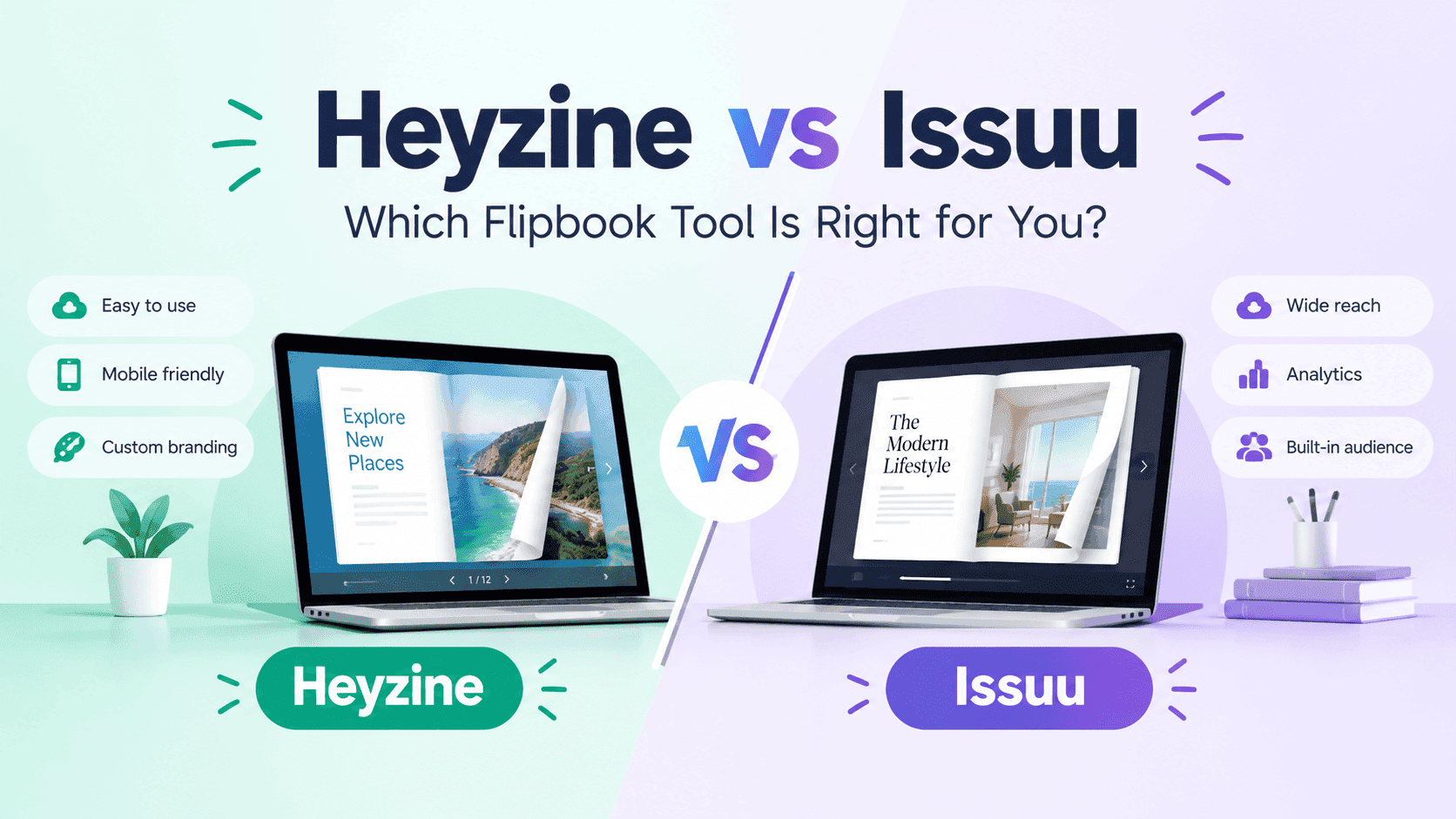
Issuu is a publishing platform with a built-in audience. Heyzine is a converter with a viewer.
Issuu started as a place to read magazines. The product is built around the idea that your publication lives on Issuu, gets indexed, might get recommended to strangers, and sits next to millions of other documents. It has added business tools over the years, but the DNA is still a publishing network. You upload, you publish to Issuu, and people find you through Issuu.
Heyzine has no network to speak of. You upload a PDF, it turns it into a flipbook, and you share a link or embed it on your own site. Nobody stumbles across your brochure on Heyzine. Plenty of businesses prefer that, because they don't want their brochure sitting next to a competitor's on someone else's domain.
Almost every difference below comes back to that split. Choose Issuu if you want reach on a third-party platform. Choose Heyzine if you want the document on your own pages. Issuu can embed too, but its center of gravity is still Issuu.
Turn Your PDFs into Lead Generation Machines
Start getting highly-qualified leads from your PDFs and landing pages today. It takes exactly 2 minutes to set up.
No credit card required • Sign up in 10 seconds
Getting your PDF in and out
Both tools convert a normal brochure or catalogue in a minute or two. Under a couple of dozen pages, you won't notice a speed difference.
Large files are where both tools start to annoy people. A 60-page product catalogue full of uncompressed photography takes a while to process and can crawl on a phone afterwards. I'd compress anything over about 20MB before uploading. If you regularly work with big files, I wrote a full post on optimising large PDFs for fast online flipbooks, and most of it applies to either tool.
Issuu treats your upload as a publication. You fill in a title, a description, maybe a category, and it gets a public page on Issuu unless you set it to unlisted or private. That's useful when you want to be found. It's a nuisance when you just want a clean link for a sales email. Heyzine gets you to a shareable link faster because there's less publishing ceremony: upload, tweak a few settings, copy the URL.
Neither tool will rescue a badly made PDF. Tiny text, low-resolution images and odd page sizes all come through faithfully, and you end up with a bad flipbook that turns pages nicely.
Turn Your PDFs into Lead Generation Machines
Start getting highly-qualified leads from your PDFs and landing pages today. It takes exactly 2 minutes to set up.
No credit card required • Sign up in 10 seconds
Embedding on your own website
Small businesses should pay close attention here: a flipbook on your own site usually earns more than one sitting on someone else's.
Heyzine's embeds drop the flipbook into your page with your layout around it. Issuu's embeds work, but the experience can pull readers toward Issuu, with its branding, related publications and links that lead away from your page. On the free plan, that's obvious. Paid plans give you more control, but how much depends on the tier.
Test the embed on your actual site before you decide. Open it on a phone, tap around, and see where the links go. It takes five minutes and saves a lot of regret.
Embeds won't fix a slow site. If your page is heavy, a flipbook will still feel slow. Loading it lazily, below the fold or behind a click, helps more than whichever tool you pick.
Lead capture and analytics
If you're using a flipbook to sell something, this matters more than the page-turning animation.
Issuu gives you stats on reads, time spent and where readers come from. That's fine for a publisher comparing one issue against another. It's thin if you want to know who opened your price list, because anonymous read counts only go so far. Gating and lead capture on Issuu depend on the plan, and the useful features sit on the pricier tiers.
Heyzine offers lead capture forms and protection options like passwords and download controls, again depending on plan. For a small business sending a catalogue to prospects, a form in front of the document is the feature that turns a flipbook into something that brings in enquiries. Check which plan actually includes it. Features move between tiers more often than the pricing page admits.
That's the weak spot: neither tool makes lead capture a first-class feature unless you pay up. It's why I put it in the free version of ZipFlipbook, but that's my bias talking and no reason to pick one of these two over the other.
Pricing and the free plan trap
Both free plans are built to make you try the product, then notice what's missing.
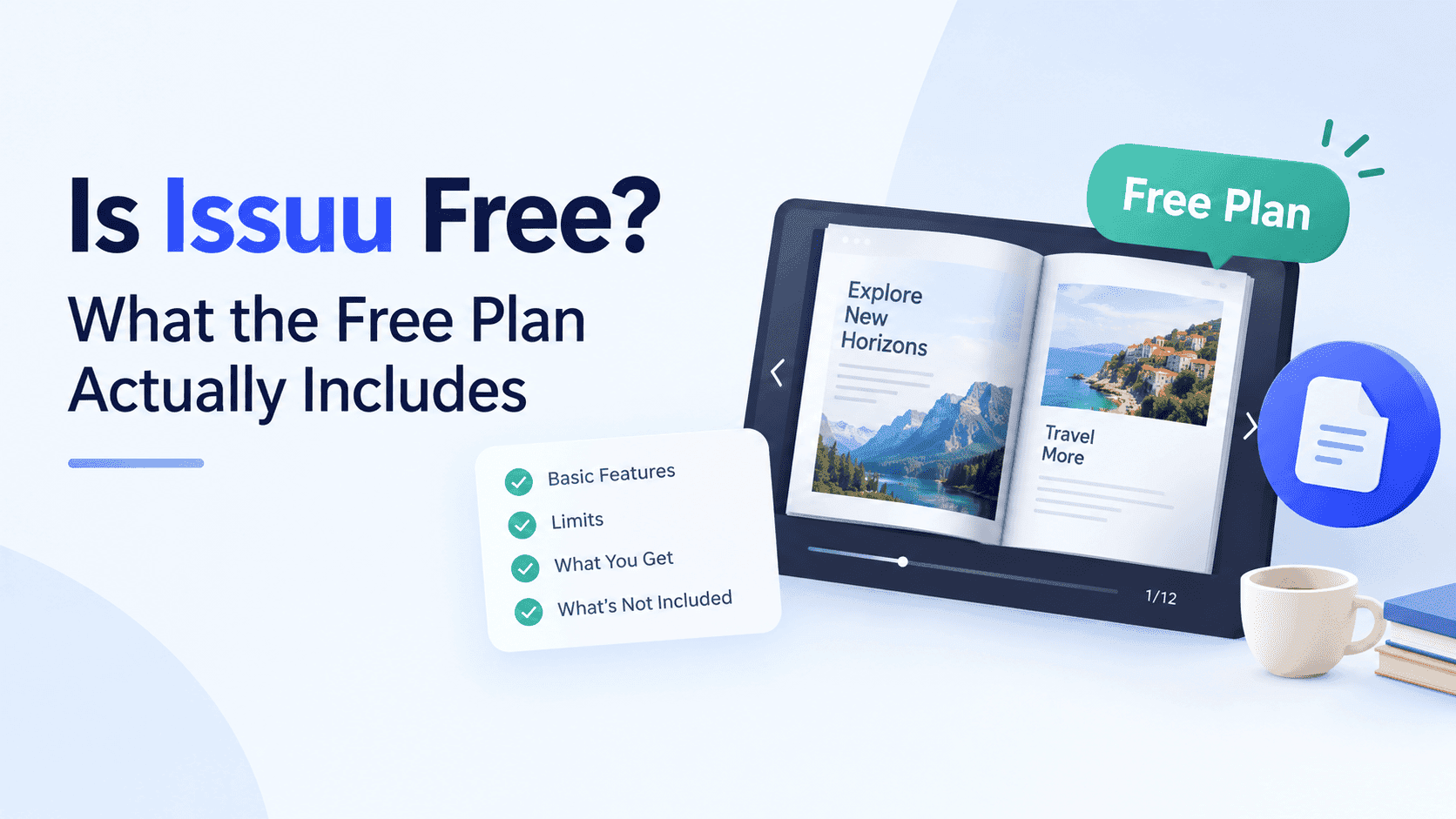
Issuu's free plan caps the number of publications, puts Issuu branding on your content, and holds back the features that make a document useful for business, such as links, video and tracking. Heyzine's free plan limits how many flipbooks you can make and stamps its own branding on them. Either is fine for a one-off personal project like a wedding album or a school magazine. Neither suits a business that wants a clean, branded, permanent document.
The mistake is comparing the monthly headline price and ignoring what sits behind it. Count how many documents you get, whether branding comes off, whether you can use a custom domain, whether lead capture is included, and what a second seat costs. Then check annual versus monthly billing, because several flipbook tools charge noticeably more if you pay monthly.
For a single small business with a handful of documents, Heyzine usually costs less to get a clean, unbranded flipbook. For a publisher with a long back catalogue who wants an audience, Issuu's price buys distribution as well as hosting. If you don't need distribution, you're paying for something you won't use.
Which one fits which person
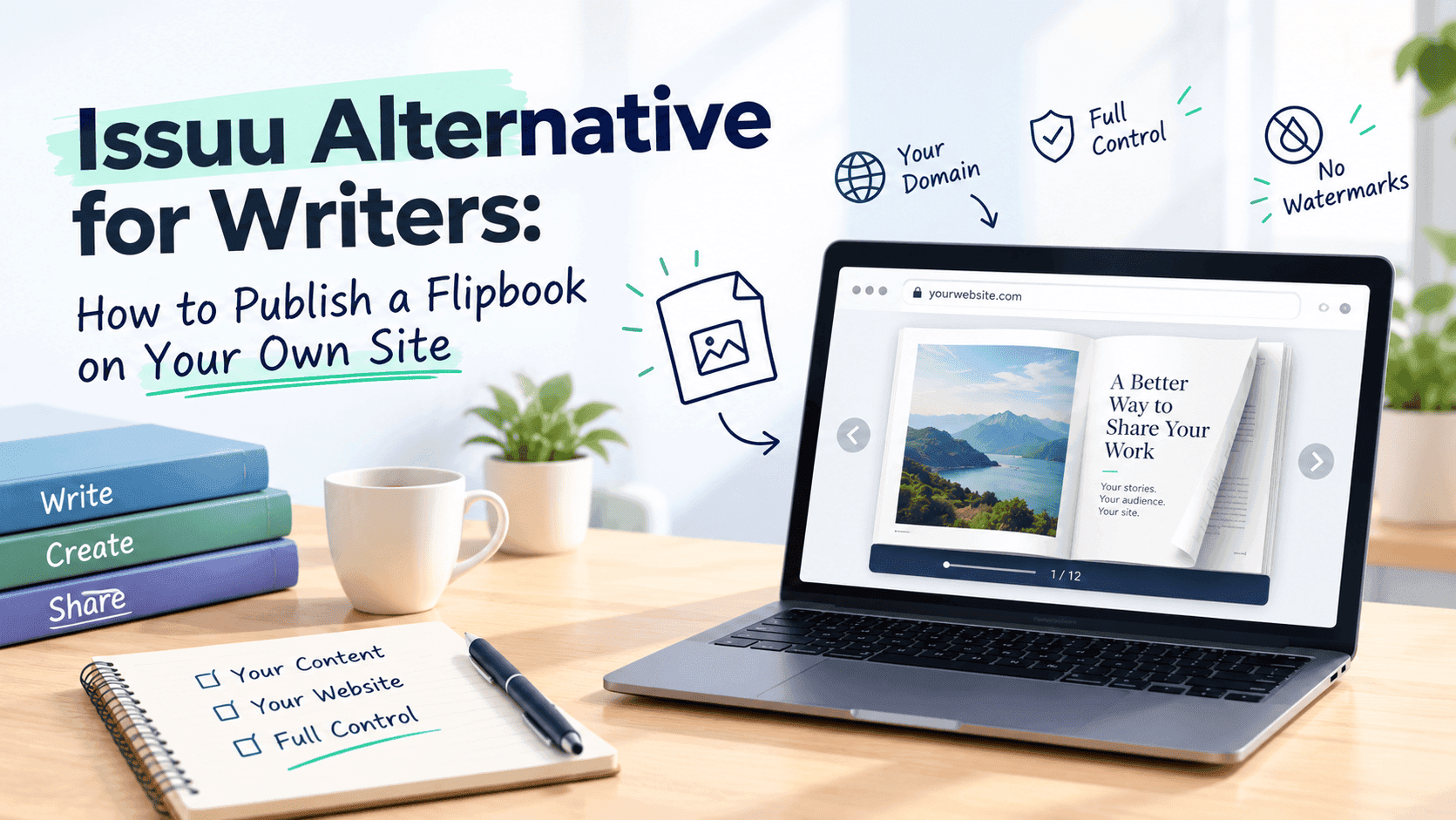
Publish a magazine, zine or regular newsletter and want a shot at new readers? Use Issuu. The platform has real discovery value, and people who look for magazines already know where to go. A poetry zine or independent magazine gets far more from a public Issuu page than from a private link. I covered one side of this in my piece on why writers look for an Issuu alternative once their needs outgrow the platform.
Run a business and want a brochure, price list or catalogue that lives on your website and goes out to customers? Use Heyzine. You keep the traffic, you control where the document sits, and you aren't sharing a page with whatever Issuu recommends next. If Heyzine doesn't cover everything you need, my post on the best Heyzine alternative for small businesses goes through where it falls short.
Need serious lead capture, deep analytics, or a document gated behind an email form? Read the plan details on both very carefully, and price up a third option too.
Need a flipbook for one event and never again? Use whichever free plan you can get working fastest. Don't agonise over it.
A few things people overlook
Test the flipbook on your phone. A flipbook that looks lovely on desktop can be fiddly on mobile, with tiny pages and awkward pinch-to-zoom. Most of your readers will be on a phone, so open your finished flipbook on yours before you send it to anyone.
Think about search visibility. Issuu pages can rank in Google, which helps if you publish content people search for, but Issuu's domain collects that authority rather than yours. A Heyzine flipbook embedded on your own page adds content to that page, though the flipbook itself usually won't rank alone. That trade-off is simple: reach or ownership.
Have an exit plan. If you build your whole catalogue on one platform and they change their pricing, you have to rebuild links, embeds and possibly QR codes. Keep your original PDFs somewhere safe, and hold off printing QR codes on physical material until you're sure of your choice.
Turn Your PDFs into Lead Generation Machines
Start getting highly-qualified leads from your PDFs and landing pages today. It takes exactly 2 minutes to set up.
No credit card required • Sign up in 10 seconds
FAQs
Is Heyzine better than Issuu? For a business embedding a catalogue on its own site, usually yes. For a magazine or zine chasing readers, no. It comes down to whether you want ownership or reach.
Is Issuu free to use? Issuu has a free plan, but it's not free in the way most businesses need. You get limits, Issuu branding and fewer business features. Check the current pricing page before you commit.
Can I embed a Heyzine or Issuu flipbook on my website? Yes. Both give you embed codes. The difference is what comes with them: branding, outbound links, and how much the embed pulls readers away from your page. Test it on mobile before you decide.
Which tool is better for lead capture? Neither is great on free. On paid plans, compare the exact tier you'd need. Both treat lead capture as an upsell, not the main event.
Will a flipbook help my SEO? Only in a specific way. An Issuu page can rank, but it builds Issuu's authority more than yours. A flipbook embedded on your own page adds content to your page, though the flipbook itself rarely ranks on its own.