Last month a reader emailed me her Joomag bill. Two years of it. She'd added up the subscription, the hours lost fighting the editor, the client who bounced off a slow-loading catalog, and the three months she kept paying after she'd basically stopped using it because cancelling felt like a hassle. The total made her wince. Mine would have too, back when I was running Slingshot Marketing and testing every tool under the sun to make brochures for tradespeople who didn't care about "digital publishing platforms." They just wanted their PDF to stop looking like a PDF.
Joomag is a serious tool. It's been around forever, it does a lot, and if you're a mid-size publisher with a team managing subscriptions and paywalled content, it's probably the right shape for you. Most people searching for a Joomag alternative aren't that. They're a roofing company, a boutique retailer, maybe a two-person agency — people who got quoted a price that made them wince, or opened the editor and needed half a day just to find the buttons.
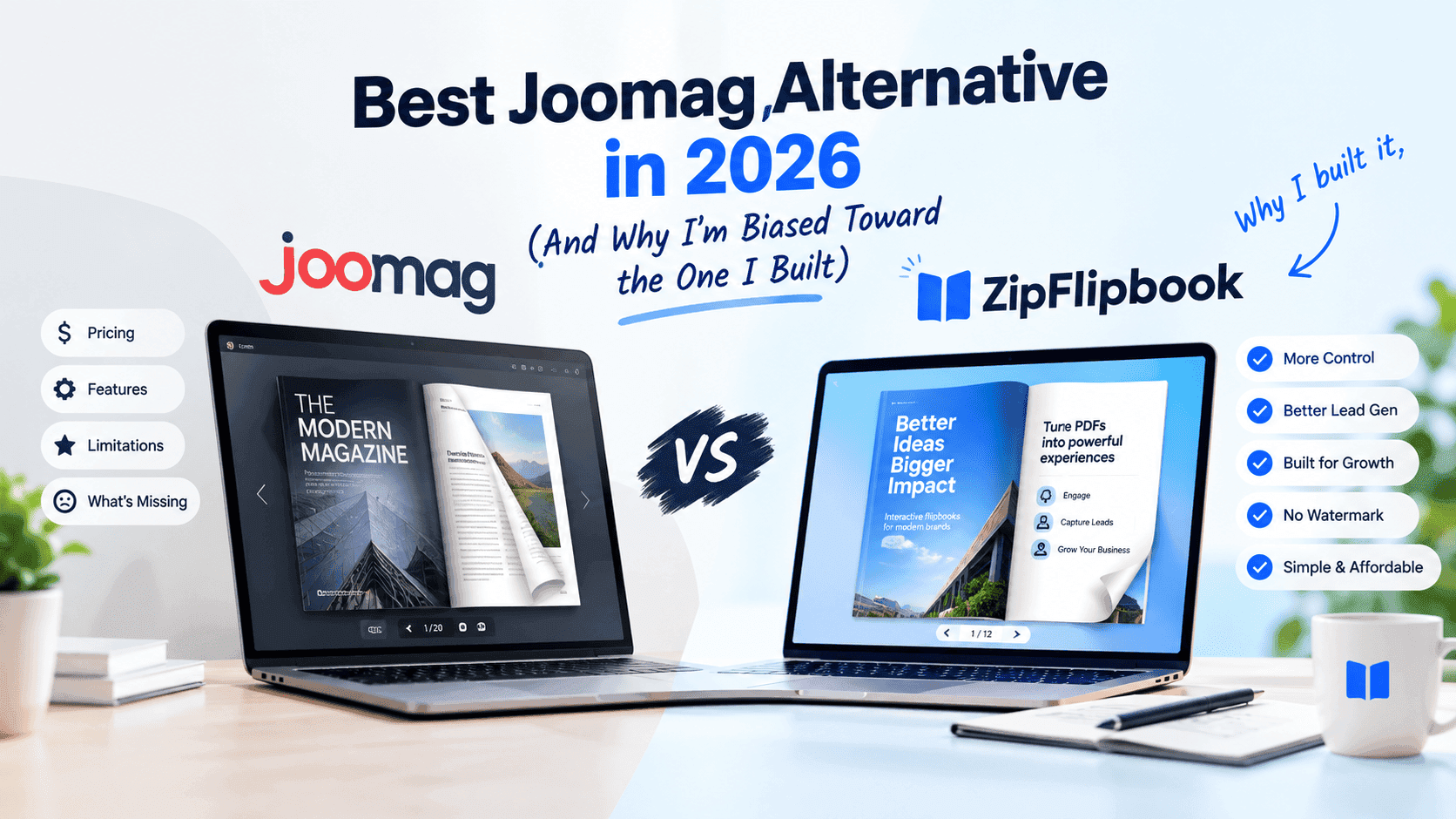
Here's what Joomag does well, where it breaks for smaller teams, and what else is out there — including the one I built.
What Joomag Gets Right
Joomag built its name as a full publishing suite. If you're running a subscription magazine with gated issues, recurring billing, and a reader app, it has the plumbing for that. Its stats dashboard is detailed — you can see reader-level engagement in a way lighter tools don't bother with. The template library is deep, too, if you'd rather start from something pre-built than a blank canvas.
But that infrastructure costs money and takes time to learn. A landscaping company that wants to send prospects a seasonal brochure ends up paying for subscription management it will never touch.
Turn Your PDFs into Lead Generation Machines
Start getting highly-qualified leads from your PDFs and landing pages today. It takes exactly 2 minutes to set up.
No credit card required • Sign up in 10 seconds
Where People Start Looking Elsewhere
Three complaints come up repeatedly in reviews and forums, and they matched almost exactly what I used to hear from agency clients back when I was doing this work by hand for them.
Pricing gets expensive fast. Joomag's free tier is thin, and the jump to a paid plan that removes watermarks and unlocks decent storage climbs quickly. One client of mine published a single catalog every quarter and was paying for a plan that sat mostly idle the other eleven months.
The editor slows you down. Several users describe spending longer fighting page layout quirks than actually designing. If your source material is already a finished PDF — and it is, for most small businesses, since it came out of Canva or InDesign or plain old Word — you don't want an editor. You want an upload button.
Lead capture is an afterthought. This is the expensive one. If nobody can tell who read your brochure, it's a dead end with good typography. Someone opens your catalog, gets three pages in, closes the tab — and you have no idea it happened unless the platform was built to tell you.
Support and onboarding become a problem a few weeks in, too. Joomag's more advanced features — subscription billing, paywall settings, app-store distribution for a branded reader app — assume someone on staff is going to own that setup and keep maintaining it. For a marketing team of one, or an agency handling this on a client's behalf, that's overhead nobody asked for. You either ignore most of what you're paying for or burn an afternoon in support docs configuring something you'll use once.
To put a number on it: Joomag's paid plans start somewhere around $19 a month once you actually need to remove watermarks, and the tier most small businesses end up needing — decent storage, no branding, a few team seats — pushes past $40. That's not outrageous for a publisher with weekly issues and a subscriber base. For someone sending out four brochures a year, it's paying rent on an apartment you visit twice.
The Realistic Alternatives
Flipsnack is usually the first one people try. It ranks well, it's solid for design-forward flipbooks, and the animation editor is genuinely nice to use. But it shares Joomag's core problem — it's built for people who want to design from scratch, not people who already have a finished PDF and want it live in five minutes. I went deeper on how the two actually compare in Flipsnack vs ZipFlipbook.
Issuu is the best-known name in the category. It helped make flipbooks feel normal in the first place. But its free tier caps you hard on views and slaps ads on your content unless you pay — an odd trade-off when the whole point is looking professional in front of a prospect. I wrote about this for smaller teams specifically in our guide to Issuu alternatives for small business.
FlipHTML5 is the cheap option, and it's fine if all you want is page-turn animation. Where it and most tools at that price point fall short is analytics. You get views, maybe, but nothing telling you who's looking or whether they're worth calling back.
If you want the wider field laid out side by side instead of just my take on three of them, I compared the free tiers of the major digital magazine makers in this rundown before you commit to anything.
I had a client — a wedding photographer, not exactly rolling in cash in her first two years — who signed up for Joomag because a competitor used it and she figured she should too. She used it for one portfolio. Then never touched it again because updating it meant re-learning the editor from scratch every time. That's the pattern I saw over and over: not people hating the product, just people paying for a habit they'd already abandoned.
Turn Your PDFs into Lead Generation Machines
Start getting highly-qualified leads from your PDFs and landing pages today. It takes exactly 2 minutes to set up.
No credit card required • Sign up in 10 seconds
Where ZipFlipbook Fits
I built ZipFlipbook, so take this section with the bias it deserves. I was running an SEO agency, making brochures and catalogs for tradespeople and small retailers on a near-weekly basis, and every tool I tried either charged me for capability I'd never use or forced me through an editor when all I had was a finished PDF sitting on my desktop. So I built the tool I actually wanted.
ZipFlipbook runs in the browser and is free. Upload a PDF, and you get an interactive flipbook back — page-turn animation included — usually in under a minute. No install, no account wall before you can see the output.
For lead capture, you can attach a form to your flipbook so a reader has to give you an email or phone number before or during viewing, and you get analytics behind it: which pages people lingered on, where they dropped off, whether they finished the whole thing. A brochure that looks nice is useless if it doesn't tell you who to call next.
You can also embed video and other media directly into the pages — useful in real estate or hospitality, where a walkthrough clip sitting next to the floor plan beats a QR code half your prospects won't scan. And because it's embeddable, you drop the finished flipbook straight into your existing website instead of sending people to a separate reader page. It sounds small, but it's the difference between looking like a real business and looking like someone attached a PDF.
One real estate agent I worked with used to hand out printed property brochures at viewings and lose half of them to the back seat of someone's car. She switched to sending a link instead — same brochure, same photos, but now with a walkthrough video on page three and a form on the last page asking for a name and number "for the full spec sheet." She started getting call-backs from people who'd never have picked up the phone unprompted. Nothing about that required a publishing platform. It required the brochure to remember who looked at it.
Will it replace Joomag for a publisher running subscriptions, a paywall, and a reader app? No. But if you're a business that needs PDFs to look good, capture a name and email, and cost nothing to try, it's built for exactly that gap.
A Word on Migrating Existing Content
If you've already got a back catalog sitting in Joomag and you're weighing whether the switch is worth it: you almost certainly still have the original PDFs, since that's how you got them into Joomag in the first place. Pull those files, run them through whichever alternative you're testing, and you've recreated your library without an export tool or a support ticket. You lose historical view data from the old platform, but for most small businesses that data was thin enough not to matter. One exception — if you built pages natively inside Joomag's editor rather than uploading a finished PDF, export to PDF first before you move anywhere else.
Turn Your PDFs into Lead Generation Machines
Start getting highly-qualified leads from your PDFs and landing pages today. It takes exactly 2 minutes to set up.
No credit card required • Sign up in 10 seconds
How to Test Them
Don't take my word for any of this. Take the PDF you're already using — your current catalog, your latest brochure, whatever's sitting in your downloads folder — and run it through two or three of these tools in the same afternoon. Time yourself. See how long it takes to get from upload to something you'd actually send a client. Check whether analytics require an upgrade. Check whether lead capture exists at all.
That's what convinced my old agency clients, every time. One ran the same catalog PDF through Joomag, FlipHTML5, and ZipFlipbook back to back on a Tuesday afternoon and picked the one that had a working lead form live before her coffee went cold. Five minutes of actually using a tool tells you more than any comparison post, mine included.
You can run that test with ZipFlipbook right now without giving up an email address first — zipflipbook.com is free to try.
Bottom Line
Joomag earned its reputation, but it was built for publishers. Most people searching for an alternative aren't publishers — they're small businesses that need their PDFs to stop behaving like PDFs and start telling them who's actually reading them. If you're managing subscriber content at real scale, Joomag's complexity is worth it. If you're not, a lighter, purpose-built tool will get you there faster. Try a few. Time them. Pick whichever one gets you to a client-ready flipbook fastest, with the analytics to back it up.